Decarbonisation and other environmental priorities
As both a manufacturer and a solutions provider, we look for opportunities, both in our own processes and in support of our customers’ operational activities, to reduce our operational climate footprint. We do that by leveraging our technology-based portfolio and making conscious design and production choices: monitoring data, avoiding waste, prioritising effective energy and emissions management, and focusing on low-carbon solutions.
Our ambition
Toyota Material Handling Europe has been making serious efforts to reduce its impact on the environment. We work hard to reduce greenhouse gas (GHG) emissions throughout our entire supply chain, aligning our climate mitigation targets with European standards, and going beyond. The goal is to reach net zero greenhouse gas emissions across our value chain by FY2041. Targets to reach this goal were submitted to and approved by the Science Based Targets initiative (SBTi) in 2024.
Our Net Zero programme requires coordinated action across the value chain, both upstream and downstream. By enhancing operational efficiency and increasingly prioritising repair, reuse, refurbishment and recycling of products, we gradually progress towards a circular business model.
"We want to lead our industry on environmental topics
such as net zero and circularity - and we want our customers
to know that we are the partner of choice to help them
meet their sustainability objectives"
Per Fyrenius
Senior Vice President Corporate Development
Progressing on net zero
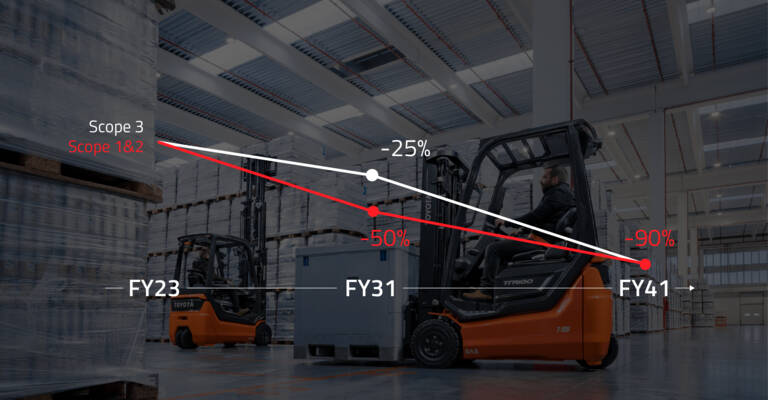
SBTi has confirmed that our near‑ and long‑term targets meet required criteria for timeframe, emissions coverage and ambition, and that our Scope 1 & 2 targets align with a 1.5°C pathway.
Our commitments include:
- 50% reduction in Scope 1 & 2 emissions by FY2031
- 25% reduction in Scope 3 emissions by FY2031
- 90% reduction across Scopes 1, 2 & 3 by FY2041
We have also set a science‑based net‑zero target to achieve full value‑chain net‑zero emissions by FY2041, the highest ambition level under SBTi. Direct reductions will come first, with remaining emissions neutralised per SBTi criteria. We remain committed to carbon management and will continue advancing energy efficiency and renewable energy across our value chain.
Initiatives today

Monitoring & preventing pollution
Toyota Material Handling Europe continuously monitors and limits the use of potentially polluting substances across its operations. Where such substances are required, they are used in small quantities and controlled environments to minimise the risk of pollution. Robust procedures are in place across our factories, sales companies and logistics sites to prevent, manage and report environmental incidents.
Our commitment to net zero and circularity also supports pollution prevention by reducing reliance on fossil fuels across the value chain. Upstream risks are managed through our Supplier Code of Conduct, including ISO 14001 requirements for strategic suppliers and performance monitoring via EcoVadis. In parallel, our R&D and purchasing teams work closely with suppliers to identify and reduce Substances of Very High Concern (SVHCs), in line with REACH regulation, ensuring transparency and compliance for our customers.

Our focus on deforestation
As part of our commitment to responsible sourcing and supply chain transparency, Toyota Material Handling Europe continues to prepare for the implementation of the EU Deforestation-free Regulation (EUDR). The regulation mainly affects materials containing natural rubber and requires full traceability from raw material origin to final product delivery. While most of our sourcing takes place within the EU, we are committed to ensuring that all products are deforestation-free, regardless of origin.
We are working closely with our suppliers to collect the necessary data and strengthen traceability across the supply chain. In light of recent EU developments, the EUDR compliance deadline is expected to be postponed to December 2026. We are closely monitoring regulatory decisions and will resume implementation activities once the revised requirements are confirmed.

Prioritising circularity
Circularity is a core pillar of Toyota Material Handling Europe’s sustainability strategy, supporting emissions reduction, innovation and long-term business resilience. We have established a circular economy policy aligned with Toyota Industries Corporation and are developing a cross-functional strategy focused on extending product lifespans, minimising waste and increasing recycled materials. Several initiatives are already underway, including parts remanufacturing, truck life extension and a European lithium recycling network. Our Design for Environment (DfE) team embeds eco-design practices, ensures regulatory compliance and measures product environmental performance. Together, these actions drive our transition towards a more circular and resource-efficient business model.
We have finalised a new Life Cycle Assessment (LCA) methodology aligned with ISO 14040 and 14044 to standardise how we assess the environmental impact of our products. A pilot study on the SWE120 pedestrian pallet stacker is validating the approach and generating insights across the full product life cycle. This work supports improved circularity, supplier engagement and more sustainable product design.
The Refurbishment Centre in Ancenis restores, repairs and refreshes used trucks, extending their lifespan and supporting a more circular business model. Launched in 2021, the 3,000 m² facility brings together skilled technicians and an industrial process aligned with the Toyota Production System. By delivering high-quality reconditioned trucks across Europe, the centre helps reduce resource use while offering sustainable solutions to our customers.
Our circular economy strategy
Key achievements so far
Certified environmental management to identify risks and assess impacts
Certified ISO 14001 compliant environmental management procedures are in place in all our factories and are being implemented in all our sales companies. All major suppliers are equally expected to be ISO 14001 certified and required to sign our Code of Conduct for Suppliers, which sets out specific requirements on pollution control from our suppliers. The EcoVadis assessment we are rolling out to all our suppliers will also enable us to manage the upstream risk.
According to EU REACH regulation, the company has a duty to inform customers on all our products containing a substance of very high concern (SVHC). We update our REACH letter on our website annually to ensure our customers have access to this data.
Mobilising our value chain using the EcoVadis platform
Environment is one of the four areas which EcoVadis scores us on - and the area where we receive the highest ‘outstanding’ rating of 90%.
In parallel, we continue engaging with customers, suppliers, employees and society at large to accelerate decarbonisation. Since our previous report, we have invited partners to the EcoVadis platform to increase ESG transparency. Additionally, over 400 suppliers shared their carbon maturity rating with us on the EcoVadis platform.
PFAS
In 2025, we launched a comprehensive due diligence programme to address growing regulatory scrutiny and customer concerns regarding PFAS (per- and polyfluoroalkyl substances), a group of over 10,000 industrial chemicals known to pose risks to human health and the environment.
As part of this initiative, we engaged suppliers to provide detailed information on PFAS content in materials and components, while conducting internal risk assessments to map potential PFAS use across our products and manufacturing processes. These efforts aim to guide the evaluation of safer alternatives, strengthen risk mitigation strategies and ensure compliance with evolving regulations, ultimately reducing environmental and health impacts while supporting our customers’ sustainability goals.
Quick links